

The Shadow Log #3: The Data War
When Evidence Becomes the Battlefield

#3 in The Shadow Log, an investigative series documenting Operation Metro Surge. Previous: #2 The Private Sector Fault Line. Updated January 30, 2026.
I. The “Dark” Deployment: The Evidentiary Vacuum
The St. Paul Field Office Reality
ERO St. Paul Field Office Director Samuel Olson’s written testimony documented a striking fact: the office had zero body-worn cameras physically located in the region during Operation Metro Surge. According to his statement, “At this time, the ERO St. Paul Office is not scheduled or funded for BWC deployment. ICE law enforcement personnel out of the ERO St. Paul Offices are not properly prepared, trained, or equipped for an immediate deployment of BWC use.”
This deployment occurred against the backdrop of significant budget reductions. The Trump administration’s fiscal 2026 budget proposal sought to cut ICE’s body-worn camera program by approximately 75 percent, reducing funding from roughly $20.5 million to $5.5 million while shrinking supporting staff from 22 positions to three. House appropriators rejected the proposed cuts and instead allocated $20 million for BWCs, though the bill did not mandate their use.
This trend indicates a clear inverse relationship: as enforcement operations intensified in scale, documentation capacity contracted.
The Evidence Framework
In civil litigation, the absence of primary-source evidence requires reliance on secondary sources, such as witness statements, circumstantial evidence, and reconstructed timelines. The quality of fact-finding typically degrades when primary evidence is unavailable.
Homicide investigations present a different challenge. When investigating officers are also subjects of investigation, when evidence remains in federal custody, and when federal authorities initially blocked state investigators from accessing crime scenes, the evidentiary framework becomes contested terrain.
Federal operations federal operations generating minimal primary evidence of their own conduct while initiating investigations into citizens who documented federal activities in public spaces.
The Policy Context
The Biden administration issued an executive order mandating body cameras for federal law enforcement, which Trump rescinded in 2025. A 2024 report indicated ICE expected agency-wide implementation by September 2025. That timeline did not materialize for Minnesota operations.
CBS News reported that some agents involved in Pretti’s shooting had body cameras. This created a documented inconsistency: some deployed agents had cameras, while the St. Paul field office maintained none on site. This discrepancy suggests that surge deployments may pull personnel from established offices, leaving behind documentation and infrastructure.
II. The Observation Networks: Coordinated Documentation
The Minneapolis Groups
While federal agents deployed without comprehensive recording equipment, Minneapolis residents developed observation networks using Signal and Telegram. These encrypted messaging groups coordinated real-time documentation of federal operations across the city.
[UPDATED: January 30, 2026] Conservative journalist Cam Higby published evidence on January 24, 2026, claiming to have infiltrated multiple Minneapolis-area Signal groups. Higby’s published screenshots, audio clips, and detailed descriptions document organizational characteristics:
Signal groups approaching the platform’s 1,000-user limit with daily rotations
Live dispatch voice calls with up to 50 participants, coordinating observation activities
Participants dispatched to document and tail identified vehicles
Timestamped photographs and license plate documentation shared in spreadsheets
Designated roles include “patrollers” and “plate checkers.”
[UPDATED: January 30, 2026] Higby’s published evidence triggered FBI Director Kash Patel’s criminal investigation and received widespread coverage from Fox News, Yahoo News, and other outlets, which reported the network details consistently. NBC News reported it has not independently verified Higby’s claims through its own access to the networks, though no major outlet has disputed the authenticity of Higby’s published evidence.
The Coordination Infrastructure
Mainstream confirmation of these networks arrived when the Associated Press published detailed reporting on January 29, 2026. AP reporting describes “interlocking webs of dozens, perhaps hundreds, of rapid response networks — sophisticated systems involving thousands of volunteers who track immigration agents, communicating with encrypted apps like Signal.”
Andrew Fahlstrom, who helps run Defend the 612, told AP that volunteers felt relief when Border Patrol commander Gregory Bovino was removed from Minneapolis following the Pretti shooting. The AP profiled an observer known as “Sunshine,” a healthcare worker who patrols St. Paul neighborhoods in her Subaru, watching for federal agents. Jason Chavez, another observer, told AP: “I saw people alerting neighbors that ICE was in their neighborhood. And that’s what neighbors should continue to do.”
The use of Signal, an encrypted messaging platform, reflects a specific operational choice. Unlike social media platforms with public posts, Signal provides end-to-end encryption that prevents platform operators or third parties from accessing message content. This architectural difference shapes how information flows during coordinated observation activities.
Social media platforms like X (formerly Twitter), Facebook, and Instagram played complementary roles. Public posts on these platforms documented incidents after they occurred, creating timestamped public records. The contrast between encrypted coordination channels and public documentation platforms creates a two-tier information architecture: private coordination alongside public accountability records.
Max Shapiro, who recorded the January 13 Pretti incident, told NBC News he was “tipped off by Signal chats and friends in the area about Immigration and Customs Enforcement presence at the intersection and went because his son’s day care center was nearby.” This documented use case shows Signal functioning as a neighborhood alert system for federal law enforcement presence.
The coordination pattern mirrors structures used in other contexts: encrypted platforms for real-time coordination, public platforms for documentation and awareness. This approach appears in various civic organizing contexts, from neighborhood watch programs to journalism networks documenting events as they unfold.
The Scale Question
FBI Director Patel’s investigation focuses on whether coordination at this scale crosses legal boundaries. The questions under investigation appear to include:
Does coordinated observation constitute obstruction of federal operations?
Does sharing publicly observable information (license plates, locations) become a conspiracy when systematized?
Does encrypted communication for coordination purposes indicate criminal intent?
Any criminal theory here would be statute-specific. “Obstruction” in federal law typically ties to defined proceedings (e.g., agency proceedings under 18 U.S.C. §1505) or to forcible interference with officers (often litigated under 18 U.S.C. §111), rather than a free-floating ban on coordinated observation.
The harder—and more fact-dependent—question is where documentation and coordination end and unlawful interference begins. Courts tend to analyze intent, threats or harassment, and whether conduct actually impedes official duties, rather than treating “scale” alone as dispositive.
Federal Counter-Documentation: The Observer Database
While investigating Minneapolis residents for documenting ICE operations, federal authorities were simultaneously building their own database of observers and protesters. Early January 2026, a DHS official in Minneapolis sent a memo to ICE Homeland Security Investigations officers on temporary assignment. The memo requested agents use a standardized form to “capture all images, license plates, identifications, and general information on hotels, agitators, protestors, etc., so we can capture it all in one consolidated form,” according to correspondence reviewed by CNN.
The database effort extended beyond Minneapolis. A video from Maine showed a federal agent recording the license plate of a woman observing an ICE operation, telling her, “We have a nice little database, and now you are considered a domestic terrorist.” Following public attention to the video, a DHS spokeswoman denied the agency was compiling a database of “domestic terrorists.”
Tom Homan, Trump’s border czar, publicly endorsed creating such a database. On Fox News in early January, Homan stated: “One thing I’m pushing for right now... we’re going to create a database where those people that are arrested for interference, impeding, and assault, we’re going to make them famous. We’re going to put their face on TV. We’re going to let their employers, in their neighborhoods, in their schools, know who these people are.”
On January 28, DHS publicized an online tip form soliciting information about people allegedly harassing ICE officers.
The recorded parallel:
Minneapolis residents using Signal to share license plates and locations → FBI criminal investigation
Federal agents collecting images, license plates, and identifications of observers → Characterized as standard operational practice
Alex Pretti’s case demonstrates the system in operation: Sources told CNN that federal officers “had documented details about Alex Pretti before he was shot to death on Saturday.” A CBP internal review subsequently confirmed federal agents possessed information about Pretti prior to the January 24 shooting, though the nature of this documentation and how Pretti first came to federal attention is unclear. What’s established: approximately one week before his death, five agents tackled Pretti during a January 13 encounter. He was released at the scene. Eleven days later, he was shot multiple times while recording federal agents with his phone.
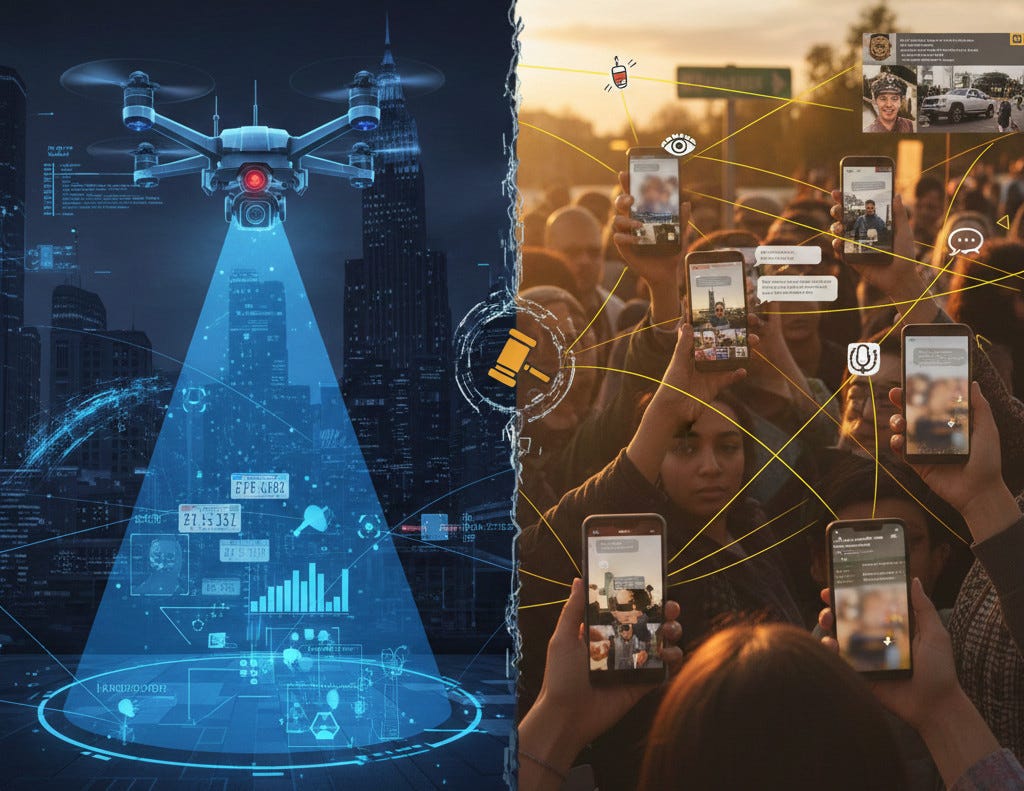
The evidentiary asymmetry: federal agents without body-worn cameras building databases on citizens, recording them with personal phones.
Federal Surveillance Technology: The Technical Asymmetry
While investigating Minneapolis residents for using encrypted messaging to share publicly observable information, federal authorities deployed an array of surveillance technologies that operate without judicial oversight. The Washington Post reported on January 29, 2026, that ICE received substantial funding increases in 2025, enabling the acquisition of state-of-the-art surveillance systems.
Biometric identification in the field:
Mobile Fortify app (NEC Corporation): Designated “high-impact” surveillance tool providing real-time facial recognition and fingerprint scanning, comparing against immigration databases
Iris scanning app (BI2 Technologies): Reads iris within seconds from 15 inches away
Julio Garcia, a Bloomington resident, described in a court declaration how agents detained him on January 9, used facial recognition to confirm his citizenship, and then released him
Data integration platforms:
Palantir Technologies: ICE’s primary data analysis platform, integrating information from multiple surveillance systems into unified operational intelligence
According to the American Immigration Council reporting (December 18, 2025), ICE uses integrated AI services connecting biometric identification, location tracking, and database queries into a coordinated surveillance infrastructure
Facial recognition databases:
[UPDATED: January 30, 2026] Clearview AI contract ($9.2 million, September 2025): Federal contract justification documents dated September 9, 2025, detail ICE/HSI’s expanded use of Clearview AI facial recognition technology. The system provides access to a database of more than 50 billion facial images scraped from public online sources. Originally restricted to child exploitation investigations when HSI began using the technology in June 2019, the contract scope expanded to include “identifying and apprehending individuals involved in assaults against law enforcement officers.” The contract justification, posted to SAM.gov on August 6, 2025, characterizes Clearview’s facial recognition as essential for ICE operations, noting the technology’s multi-database architecture that enables forensic linkage back to the original webpages where images were found.
Location tracking without warrants:
Penlink system (contract awarded September 2025): Monitors social media and phone surveillance, tracks city blocks and neighborhoods
Tracks movements of smartphones, smartwatches, and other connected devices
Uses commercial and publicly available location data from hundreds of millions of phones
Accessible without a warrant, according to 404 Media reporting
Additional surveillance systems:
License plate readers (confirmed by ACLU Minnesota)
Drones
Mobile phone location databases
Automation of Suspicion: The BLUF Pipeline
Recent reporting disclosed that ICE has been using Palantir-linked generative AI tooling to process public tips submitted through federal reporting systems. The AI system generates brief summaries known as BLUFs (Bottom Line Up Front), translates non-English submissions, and helps prioritize which tips warrant immediate attention.
This represents a qualitative shift from surveillance to automated triage. Human stories become machine-readable urgency scores. Narrative complexity compresses into algorithmic priority rankings. The system processes incoming information at machine speed, creating a technical advantage in determining which observations matter.
Against this automated processing infrastructure, citizen observers produce counter-metadata: timestamps embedded in video files, GPS coordinates in photo EXIF data, license plate documentation across multiple independent sources, cross-referenced timelines from uncoordinated witnesses. These are raw inputs designed to resist compression, requiring human review to dismiss or distort.
The asymmetry is not just what gets recorded. It is who controls the speed and structure of analysis. Federal systems automate prioritization. Citizen networks distribute verification. In contested events, both approaches create evidentiary records, but only one requires preserving the original complexity.
The documented contrast: federal agents using warrantless biometric scanning, iris recognition, phone tracking, location databases, and AI-powered data integration platforms to monitor populations while simultaneously investigating citizens for photographing publicly visible license plates and sharing observations through encrypted messaging.
John Boehler, ACLU Minnesota policy counsel, characterized the situation: “Data is being weaponized. It’s being weaponized by a hostile federal government, and that was always the intended use for all that data collection.”
Note for future development: The surveillance technology deployment warrants dedicated examination exploring Palantir’s role as the data integration backbone, the legal frameworks governing warrantless surveillance, the technical capabilities of each system, accuracy rates, and racial bias in biometric identification, the vendor platform ecosystem enabling mass surveillance, and the contrast between federal surveillance powers and citizen documentation rights under First Amendment protections. The American Immigration Council has documented ICE’s integrated AI surveillance infrastructure, which enables comprehensive population monitoring.
The Federal Response
On January 27, 2026, FBI Director Kash Patel announced a criminal probe into these messaging groups. In an interview with conservative podcaster Benny Johnson, Patel stated: “As soon as Higby put that post out, I opened an investigation on it.”
Patel’s statement framed the investigation scope: “We immediately opened up that investigation because that sort of Signal chat being coordinated with individuals, not just locally in Minnesota, but maybe even around the country, if that leads to a break in the federal statute or a violation of some law, then we are going to arrest people.” Patel did not specify which statute might apply, leaving legal observers to infer potential reliance on obstruction or officer-interference theories.
The investigation targets activities such as sharing license plate numbers and the locations of federal agents. Patel argued: “You cannot create a scenario that illegally entraps and puts law enforcement in harm’s way.”
The Constitutional Framework
First Amendment scholars responded to the announcement of the investigation with an analysis of relevant precedents. Aaron Terr of the Foundation for Individual Rights and Expression stated: “The Constitution takes precedence over any conflicting state or federal law, and over any official’s desire to suppress speech they dislike.”
Alex Abdo of the Knight First Amendment Institute at Columbia University emphasized: “The ability of everyday citizens to hold government agents to account, by observing them and advocating for change, is what has distinguished the American experiment with democracy from authoritarian regimes around the world.”
The constitutional questions center on several established principles:
The right to photograph law enforcement in public spaces—including the First Circuit’s recognition in Glik v. Cunniffe (2011) of a First Amendment right to record police performing their duties in public, subject to reasonable time, place, and manner limitations
The observable nature of license plates on government vehicles in public spaces
The separate First Amendment doctrine recognizes that compelled disclosure of membership or associational ties can chill lawful association—an idea sometimes relevant when governments seek to map or expose political networks
The federal investigation seems to examine whether the scale and effectiveness of coordination transform protected activity into criminal conduct—a fact-specific, largely untested application of existing First Amendment and obstruction doctrines to coordinated civilian documentation.
[UPDATED: January 30, 2026] The Journalist Prosecution: Testing Documentation Rights
[UPDATED: January 30, 2026] The constitutional questions surrounding civilian documentation gained additional urgency on January 30, 2026, when federal prosecutors secured a grand jury indictment against journalists Don Lemon and Georgia Fort for their coverage of a January 18, 2026, protest at Cities Church in St. Paul, Minnesota.
[UPDATED: January 30, 2026] The 14-count federal indictment charges both journalists with civil rights conspiracy under 18 U.S.C. § 241, alleging they “largely surrounded” and attempted to “oppress and intimidate” church attendees exercising their First Amendment rights. The charges stem from protest coverage documented in publicly available video showing protesters blocking church entrances while Lemon and Fort reported on the demonstration.
[UPDATED: January 30, 2026] The procedural history reveals a system under strain. Two federal magistrate judges initially declined to approve criminal complaints against Lemon and Fort, finding insufficient evidence to support probable cause. Prosecutors then sought review from the Eighth Circuit Court of Appeals, which declined to intervene in the magistrates’ decisions. Only after these denials did prosecutors present the case to a grand jury, which returned the indictment on January 30.
[UPDATED: January 30, 2026] The case presents a test of whether journalists covering protests can be held criminally liable for the actions of protesters they document. The government’s legal theory appears to rely on 18 U.S.C. § 241, a Reconstruction-era civil rights statute typically used to prosecute conspiracies to deprive individuals of constitutional rights. The statute carries potential penalties of up to 10 years in prison.
[UPDATED: January 30, 2026] Lemon and Fort were released on their own recognizance following their initial court appearance before Magistrate Judge Tony N. Leung on January 30. Release conditions prohibit contact with alleged victims and restrict travel to Minnesota, New York, California, and Georgia.
[UPDATED: January 30, 2026] The documentation parallels are direct: Federal authorities investigating journalists for documenting protests while simultaneously investigating Minneapolis residents for documenting federal enforcement operations. In both cases, the question centers on whether documentation of government activity in public spaces constitutes protected First Amendment conduct or potential criminal liability.
[UPDATED: January 30, 2026] The Lemon-Fort prosecution demonstrates federal willingness to pursue criminal charges against individuals documenting events in public spaces, even when initial judicial review finds insufficient evidence. The grand jury route, following two magistrate rejections, documents prosecutors’ determination to secure charges despite procedural obstacles.
[UPDATED: January 30, 2026] Whether courts will ultimately sustain convictions under § 241 based on protest coverage remains unresolved. The case proceeds as the federal investigation of Minneapolis observation networks continues, creating parallel tests of documentation rights under different statutory frameworks.
III. The Metadata Record: The Alex Pretti Timeline
The January 13 Incident
Video from January 13, 2026, disclosed today by The News Movement and verified by BBC News and CBS News, documents Pretti in a confrontation with federal agents eleven days before his fatal shooting. The footage shows him kicking and breaking the taillight of a federal SUV. Agents tackled him and held him down for approximately 20 seconds before releasing him.
The News Movement stated it responded to a tip about agents blocking the street at the intersection of East 36th Street and Park Avenue shortly after 10 a.m. on January 13.
The video shows Pretti wearing clothing similar to what he wore on January 24 when he was killed: black hat, brown coat, beard. A handgun is visible in his waistband. He held a valid Minnesota carry permit.
Critical detail: Multiple sources confirm Pretti was also recording the January 13 encounter with his own phone. That footage, along with video he was recording on January 24 when he was killed, stays in the Department of Homeland Security's possession under Attorney General Ellison’s evidence preservation order. The content of Pretti’s own recordings has not been publicly disclosed.
The Timestamp Evidence
Multiple bystander videos from January 24 contain embedded timestamp data. These timestamps, when compared across multiple independent recordings, create a forensic timeline of the shooting sequence.
The videos document:
Pretti’s hands were occupied by his phone during initial contact
An agent removing a gun from Pretti’s waistband during the tackle
The shooting occurred moments after disarmament
Multiple camera angles capture the sequence from different positions
When multiple independent sources with uncoordinated timestamps align, the recordings create a framework for reconstructing the event sequence. When those timestamps conflict with official statements, investigators face evidentiary conflicts that require resolution.
The Evidence Preservation Order
On January 25, 2026, approximately 24 hours after Pretti’s shooting, Attorney General Keith Ellison filed an emergency motion for a temporary restraining order to prevent the Department of Homeland Security and other federal agencies from altering or destroying evidence.
Judge Eric C. Tostrud granted the order late Saturday night.
Ellison called the situation: “This is uncharted territory. We’ve never had to do anything like this before.”
The order bars federal defendants from “destroying or altering evidence” but does not require immediate transfer of materials to state investigators. The legal action documents a departure from standard inter-agency cooperation protocols.
BCA Superintendent Drew Evans stated that in his more than 20 years at the agency, he had never encountered federal authorities blocking access to an incident where both federal and state jurisdiction applied.
Digital Evidence Under Preservation
The preservation order covers Pretti’s phone, which contains his first-person recordings from both the January 13 and January 24 encounters with federal agents. The device’s metadata could include GPS coordinates, timestamp data, and accelerometer readings during the physical confrontations.
Multiple verified videos from January 24 show Pretti holding his phone and appearing to record agents in the moments before he was tackled. ABC News timeline analysis places him “using his phone to record CBP officers” beginning at 8:58:11 a.m., more than three minutes before the shooting.
Attorney General Ellison stated in a January 27 interview: “I believe that immigration agents have that phone and all the other materials, which is why we brought a motion Saturday night to stop them from altering, tampering, or destroying evidence.”
DHS has not publicly confirmed possession of Pretti’s phone or disclosed whether it contains video from either January 13 or January 24. The family told the Associated Press they have no idea where the phone is and that federal law enforcement has not contacted them about it.
The TRO represents a documented departure from standard evidence-sharing protocols between federal and state law enforcement agencies investigating overlapping jurisdictions.
The CBP Internal Review
Following public circulation of witness videos, CBP conducted an internal review of the January 24 shooting. The review contradicted elements of the administration’s initial characterizations while confirming key evidentiary details.
According to Reuters reporting, a preliminary CBP review did not describe Pretti as brandishing a firearm. This represents a meaningful divergence from earlier public characterizations that framed Pretti as presenting an imminent armed threat. A report sent to Congress and obtained by CBS said two agents fired their weapons and did not mention Pretti reaching for his firearm. The review describes a struggle during which the gun appears to have been removed from Pretti’s waistband just before shots were fired.
A disparity emerges: the state’s first narrative traveled faster than its own paperwork. Civilian video created one record, internal review created another, public officials broadcast a third. In an evidentiary vacuum, whoever controls the first storyline often controls the default memory until documentation catches up.
The internal review occurred as Minneapolis businesses near the shooting site began actively supporting protesters and contributing donations to legal defense funds, documenting a shift in local commercial response to federal enforcement operations.
The review’s findings remain largely internal. Federal authorities have not publicly released the complete results of the internal investigation, maintaining the pattern of limited disclosure documented throughout Operation Metro Surge.
[UPDATED: January 30, 2026] The DOJ Investigation: Federal Civil Rights Probe Opened
[UPDATED: January 30, 2026] On January 30, 2026, Deputy Attorney General Todd Blanche announced the Department of Justice opened a federal civil rights investigation into the January 24 shooting of Alex Pretti by Border Patrol agents. The investigation, led by the FBI’s Civil Rights Division, will examine both the shooting and prior encounters between Pretti and federal agents.
[UPDATED: January 30, 2026] The announcement came six days after the shooting and three days after the administration’s narrative reversal regarding characterizations of Pretti as a “domestic terrorist.” The investigation runs parallel to Minnesota’s state-level investigation, which faces the evidentiary obstacles documented throughout this article: federal control of Pretti’s phone and recordings, initial denial of crime scene access, and the absence of body-worn camera footage from St. Paul field office agents.
[UPDATED: January 30, 2026] The timeline of institutional responses:
[UPDATED: January 30, 2026]
January 24: Shooting occurs, federal agents do not activate body cameras (if present)
January 25: Minnesota AG files emergency TRO to preserve evidence
January 27: Administration begins narrative reversal, Bovino removed
January 28: Homan announces operational drawdown
January 30: DOJ opens federal civil rights investigation
[UPDATED: January 30, 2026] The parallel investigations create competing frameworks for access to evidence. The DOJ investigation adds a federal mechanism for examining the circumstances of Pretti’s death, though questions remain about which agency controls key evidence, including Pretti’s phone containing his first-person recordings from both January 13 and January 24 encounters.
[UPDATED: January 30, 2026] When primary evidence sources are absent—body-worn cameras not deployed, crime scene access initially blocked—secondary documentation from civilian observers and the emerging institutional investigations become the mechanisms for reconstructing contested events. The evidentiary vacuum documented in Section I now shapes how multiple overlapping investigations will proceed.
[UPDATED: January 30, 2026] Minnesota Attorney General Ellison stated his office would continue its investigation. Whether state and federal investigators will coordinate access to evidence, including Pretti’s phone and body camera footage from agents who were equipped with cameras, remains to be determined as both investigations proceed.
IV. The Federal Counter-Narrative: Digital Messaging as Operational Tool
The Three-Hour Timeline
On January 24, 2026, at 9:01:13 a.m., Border Patrol agents shot Alex Pretti. By 12:00 p.m., the Department of Homeland Security had published a statement on social media describing Pretti as an “armed suspect” who “violently resisted” officers’ attempts to disarm him.
Minutes after the DHS statement, White House Deputy Chief of Staff Stephen Miller posted to X: “A would-be assassin tried to murder federal law enforcement, and official Democrat accounts side with the terrorists.”
At a press conference later that day, DHS Secretary Kristi Noem stated: “This looks like a situation where an individual arrived at the scene to inflict maximum damage on individuals and to kill law enforcement.” She termed the incident “the definition of domestic terrorism.”
Border Patrol Commander Gregory Bovino told CNN that Pretti “wanted to do maximum damage and massacre law enforcement.”
The coordination was rapid. The messaging was consistent. The narrative was established before state investigators accessed the scene, before body camera footage was reviewed, before witness videos were widely circulated.
The Narrative Reversal
By Monday, January 27, the administration began distancing itself from these characterizations. White House Press Secretary Karoline Leavitt stated: “I have not heard the president characterize Mr. Pretti in that way.”
On Tuesday, January 28, President Trump told reporters: “Well, I haven’t heard that” when asked about officials calling Pretti a “domestic terrorist” or “assassin.”
Miller released a new statement suggesting agents “may not have been following protocol” and that the White House was “evaluating” the incident. This represented a significant shift from his initial “would-be assassin” characterization posted 48 hours earlier.
The reversal occurred amid pushback from multiple constituencies. Second Amendment advocates criticized the administration’s initial portrayal of Pretti, a lawful gun owner with a valid carry permit, as a would-be assassin. The characterization created tensions within constituencies typically aligned with enforcement-focused messaging.
According to Axios reporting, Noem told sources in a Monday meeting with Trump: “Everything I’ve done, I’ve done at the direction of the president and Stephen.” Miller was notably absent from this meeting.
The Social Media Architecture
The speed of narrative deployment points to a centralized messaging apparatus. DHS published its statement within three hours. Administration officials amplified the message across social media platforms within minutes. The narrative framework was established before independent verification could occur.
When witness videos circulated showing a different sequence of events, the narrative shifted. The transition from “domestic terrorist” and “assassin” to “evaluating” and “may not have followed protocol” occurred within 72 hours.
The pattern demonstrates how social media platforms function as primary narrative control mechanisms, with speed of publication becoming a strategic advantage in contested events.
The Bovino Departure
On Tuesday, January 27, Border Patrol announced that Gregory Bovino, the official who had characterized Pretti as attempting to “massacre law enforcement,” was being removed from Minneapolis operations. The stated reason was officer safety concerns.
Bovino’s departure occurred as public attention focused on his January 24 press conference statements. His removal followed the administration’s broader narrative shift away from characterizing Pretti as a terrorist.
The sequence suggests recognition that initial characterizations required recalibration as video evidence became public.
The Operational Drawdown
On January 28, border czar Tom Homan announced plans to reduce ICE and CBP presence in the Twin Cities following Operation Metro Surge. DHS publicly claimed approximately 3,000 arrests during the operation, though this figure has not been independently verified. What is documented: approximately 3,000 federal agents were deployed to Minnesota during the surge.
Homan’s statement represented a shift from the operation’s initial posture. The acknowledgment that surge-level deployment was unsustainable came as Minneapolis businesses, civic organizations, and observation networks maintained coordinated resistance to federal enforcement activities.
The drawdown announcement occurred within the same 72-hour window as Bovino’s removal and the administration’s narrative recalibration regarding Pretti’s shooting, documenting a coordinated operational and communications shift.
The Critical Irony: Government Signal Use
While FBI Director Patel announced a criminal investigation into Minneapolis residents using Signal to coordinate observation of federal agents, concurrent reporting documented extensive Signal use by Trump administration Cabinet officials for discussing sensitive government operations.
The Pentagon Inspector General investigation: Defense Secretary Pete Hegseth is under investigation for using Signal to share classified Yemen strike plans with former Fox News colleagues during the March 2025 Yemen operations. According to multiple news reports, Hegseth’s messages included:
Details of military strike planning and timing
Information about weapons systems to be used
Real-time updates during active military operations
Communications sent to journalists not cleared for classified information
When questioned about the Signal communications, Hegseth stated, “I was exonerated. Case closed. There was no investigation.” The Pentagon Inspector General confirmed the investigation remained open.
Cabinet-wide Signal adoption: Multiple Trump Cabinet members have acknowledged using Signal for government business, according to published reports:
Commerce Secretary Howard Lutnick has reportedly used Signal for discussing Commerce Department business
Interior Secretary Doug Burgum has acknowledged Signal use while expressing uncertainty about records preservation
White House Press Secretary Karoline Leavitt confirmed Cabinet members “may use Signal,” calling it “secure.”
The legal framework conflict: U.S. records law splits: the Presidential Records Act governs records of the President and Vice President (and certain Executive Office components that solely advise and assist the President), while Cabinet departments and agencies generally operate under the Federal Records Act. In either regime, auto-deleting platforms like Signal can create preservation and retrieval problems when used for official business.
A January 2025 lawsuit filed by American Oversight, a government watchdog group, alleged that Cabinet officials’ use of Signal violated federal records laws. The suit specifically targeted Signal communications among Cabinet members regarding government policy decisions. In litigation brought by American Oversight, a federal judge ordered the preservation of specified Signal messages after allegations that auto-delete settings risked violating federal record-keeping obligations.
The March 2025 Yemen context: The Hegseth Signal messages occurred during sensitive military operations:
March 11-15, 2025: The U.S. conducted strikes against Houthi positions in Yemen
Hegseth shared strike details with Fox News personalities Tucker Carlson and Pete Doocy
Messages discussed “going in big” and specific weapons systems
A federal judge later issued a preservation order for these Signal messages
The judge ordered preservation of Signal messages from March 11-15, 2025
The Pentagon’s own guidance:
March 14, 2025 (one day before Hegseth’s Yemen strike sharing): Department-wide memo warned “third-party messaging apps (e.g., Signal) are permitted by policy for unclassified accountability/recall exercises but are NOT approved to process or store nonpublic unclassified information.”
This reveals a stark operational standard: federal use of encrypted apps for classified military planning is subject to administrative or inspector-general review, while citizen use for public observation triggers a criminal investigation. Minneapolis residents who use Signal to share publicly observable license plate numbers and locations face an FBI probe. Trump Cabinet officials using Signal to share military strike plans, weapons systems, and timing have, to date, faced only administrative review rather than criminal charges.
Note for future development: This irony merits expanded examination in a dedicated article exploring the differential application of standards for encrypted communications, the documented government Signal use timeline, the legal frameworks governing Federal Records Act compliance versus First Amendment protections, and the national security implications of Cabinet officials using compromised encrypted platforms while investigating citizens for using the same technology.
V. The Documentation Pattern: When Primary Sources Don’t Exist
This section documents claims that cannot be independently verified due to a lack of primary-source evidence, illustrating the broader evidentiary challenges posed when federal operations generate minimal documentation of their own activities. Where verification is impossible, we explain why, then examine the legal frameworks that apply when evidence is withheld or unavailable.
Warrant Framework Questions
Verification needed: Claims about leaked ICE memos on administrative warrant authority require primary-source documentation before inclusion.
The distinction between administrative and judicial warrants creates different documentation standards. Administrative immigration warrants (such as DHS Forms I-200/I-205) are issued by immigration officials rather than judges. They generally do not carry the same judicial probable-cause finding or home-entry authority as a judicial warrant, and disputes are typically litigated through immigration proceedings or later court challenges rather than a contemporaneous magistrate review.
The General Strike Documentation
Verification needed: Claims about verifiable drops in digital transaction volume during the January 23 general strike require documented sources. Credit card transaction data, point-of-sale system logs, and mobile payment activity patterns would need to be sourced from financial institutions or publicly available sources.
The economic withdrawal documented in previous articles created observable patterns, but specific claims about digital transactions require verification before publication.
The Infrastructure Withdrawal Data
Verification needed: Claims about GPS data from buses, garbage trucks, and service vehicles require documentation from Metro Transit or city services. While Article 1 documented service disruptions, specific GPS-tracking data claims require primary sources.
The Evidentiary Framework
In litigation, courts can impose sanctions—sometimes including adverse-inference-type remedies—when evidence that should have been preserved is lost or withheld. For electronically stored information, Federal Rule of Civil Procedure 37(e) imposes severe sanctions in situations involving an “intent to deprive” another party of the information’s use in litigation.
Minnesota’s documented attempts to access evidence, the emergency TRO to preserve materials, and the repeated instances of federal obstruction create a procedural record. This record documents the state’s efforts to conduct a standard homicide investigation while facing barriers to evidence access.
The preservation of digital records becomes significant in contested narratives. Timestamped photographs, metadata from multiple sources, and documented attempts to access crime scenes create an audit trail independent of any single party’s narrative control.
The Internal Breakdown: Prosecutorial Resignations
The evidentiary void has internal casualties. According to the Washington Post reporting on January 29, federal prosecutors in the U.S. Attorney’s Office for Minnesota threatened mass resignation after being told they were not allowed to investigate the federal officers who shot and killed Good or Pretti. Prosecutors, including Joe Thompson who previously served as acting U.S. attorney, warned they might resign en masse, leaving the office to crumble under an unattended workload.
According to the Washington Post reporting on January 29, federal prosecutors told U.S. Attorney Dan Rosen in a meeting on Monday, January 26, that they were not allowed to investigate the federal officers who shot and killed Good or Pretti. Prosecutors expressed concern about pressure to rush criminal charges against people accused of assaulting federal officers without formal investigations, and warned this focus was interfering with other important work.
The prosecutors compared the handling to 2020, arguing that after George Floyd’s death, the investigation was not led by the department whose officer was involved, whereas here DHS was perceived as leading the review of a shooting involving DHS personnel.
According to multiple sources, prosecutors faced pressure from Justice Department leadership to investigate ties to activist groups by Good and her widow, rather than investigating the shootings themselves. Prosecutors cited a February 2025 memo from Attorney General Pam Bondi that emphasized “zealous advocacy” and warned DOJ attorneys against refusing to advance the administration’s good-faith positions, describing government lawyers in terms that critics said blurred independence norms.
Prosecutors reportedly asked Rosen what would happen if they simply opened their own investigation into the shootings and issued grand jury subpoenas. They did not receive a clear response. Shortly thereafter, prosecutors warned they might resign en masse, leaving the office to crumble under an unattended workload.
This internal revolt documents a fourth institutional response to the evidentiary vacuum: federal prosecutors refusing to participate in the suppression of investigations into federal agents’ use of deadly force. The pattern shows the state not just failing to create primary evidence through body cameras, but actively blocking its own legal apparatus from investigating when deadly force is used.
Conclusion: The Persistence of Digital Records
The operational pattern documented in Operation Metro Surge shows federal agents deployed without comprehensive recording equipment while simultaneously investigating citizens for photographing government activities in public spaces. This asymmetry creates evidentiary imbalances in subsequent investigations.
The absence of primary-source evidence elevates secondary documentation from supporting material to the definitive forensic record. Citizen-recorded video with embedded timestamps, metadata from multiple independent sources, and documented attempts to access evidence all become critical to reconstructing contested events.
The constitutional questions raised by the FBI investigation of observation networks remain unresolved. Whether coordinated documentation of law enforcement in public spaces constitutes protected First Amendment activity or potential criminal conduct awaits judicial determination.
Minnesota’s legal strategy documents the procedural obstacles encountered: crime scene access initially blocked, emergency court orders required to preserve evidence, and repeated instances where standard inter-agency cooperation protocols did not materialize.
On January 29, 2026, Chief U.S. District Judge Patrick J. Schiltz documented that ICE had violated 96 court orders across 74 cases in less than one month, stating that “ICE has likely violated more court orders in January 2026 than some federal agencies have violated in their entire existence.” Schiltz had ordered Acting ICE Director Todd Lyons to appear personally for a contempt hearing on January 30, but canceled the proceeding after ICE released detainee Juan Hugo Tobay Robles on January 28. The cancellation did not end the judicial rebuke: Schiltz published an appendix listing the violations and declared, “ICE is not a law unto itself.”
[UPDATED: January 30, 2026] This judicial documentation, combined with federal prosecutors threatening resignation over suppressed investigations and the DOJ’s January 30 opening of a federal civil rights investigation into Pretti’s shooting, represents an institutional response at multiple levels. Four distinct mechanisms have emerged to address the evidentiary vacuum: citizen observation networks documenting federal activities in public spaces, internal CBP reviews contradicting official narratives, federal judicial intervention documenting systemic noncompliance, and career prosecutors refusing to participate in the suppression of investigations. The DOJ’s civil rights probe adds a fifth mechanism, creating parallel federal and state probes that must navigate the same evidentiary obstacles—absent body cameras, federal control of key evidence, and initial denial of crime scene access. Each creates formal records of federal conduct when primary evidence sources were never deployed.
The digital records persist regardless of narrative disputes. Timestamps remain embedded in video files. Metadata documents when and where recordings occurred. Multiple independent sources create cross-referenced timelines.
In eventual litigation, the party with intact, timestamped, multiply-corroborated documentation maintains evidentiary advantages. The absence of primary-source evidence from one party, while abundant secondary documentation exists from another, creates a framework in which adverse inference arguments may be raised, subject to the evidentiary and intent requirements imposed by federal courts.
The audit trail remains intact. The ultimate question is which narrative the data will eventually validate.
UPDATES DOCUMENTED - January 30, 2026:
Section II - The Minneapolis Groups: Revised verification status of Cam Higby’s published evidence (added documentation of screenshots and audio clips, clarified NBC’s verification caveat relates to independent access rather than disputing authenticity, noted widespread corroboration from Fox News and Yahoo News, enhanced detail on organizational characteristics, including 50-participant voice calls and designated roles)
Section II - Federal Surveillance Technology: Enhanced Clearview AI documentation with federal contract justification details (50+ billion images database, June 2019 HSI usage start, September 2025 scope expansion to include assaults on law enforcement, SAM.gov posting date, multi-database architecture details)
Section II - New Subsection: Added “The Journalist Prosecution: Testing Documentation Rights” documenting January 30, 2026, federal indictment of journalists Don Lemon and Georgia Fort for protest coverage (14-count civil rights conspiracy charges, two magistrate judge rejections, Eighth Circuit decline to intervene, grand jury indictment, release conditions, parallel tests of documentation rights)
Section III - New Subsection: Added “The DOJ Investigation: Federal Civil Rights Probe Opened” documenting Deputy AG Todd Blanche’s January 30, 2026 announcement that DOJ opened federal civil rights investigation into Alex Pretti shooting (FBI Civil Rights Division leading probe, timeline of institutional responses, parallel state-federal investigations, competing frameworks for evidence access)
Conclusion: Updated to reflect DOJ’s January 30 opening of federal civil rights investigation as the fifth institutional mechanism addressing evidentiary vacuum
Original publication date: January 29, 2026
Disclaimer: This article reports publicly available statements, court documents, and news reporting without endorsement of any position or interpretation. Readers should independently verify all information presented herein. Nothing herein constitutes legal advice, opinion, or creates an attorney-client relationship.
About The Shadow Log: This investigative series documents Operation Metro Surge through dual lenses: contemporary frontline reporting and historical analysis of Minnesota’s resistance traditions. Each article combines real-time journalism with archival research to explain not only what is happening but also why these specific patterns emerged in Minnesota. Article 3 examines how digital evidence and metadata shape accountability when federal enforcement operations deploy without comprehensive recording equipment.